How Much is the Average Electricity Bill in the UK?
If you’ve recently received your energy bill and want to know if it’s higher than the national average, then read on to see if your costs are more than they should be.
Updated: Includes current price cap rates from 1st April 2024 to 30th June 2024.
If you go onto any comparison website, you’ll probably notice that there are quotes for the average electricity bill for each household around the UK. This data comes from the set figures of the energy regulator Ofgem for all electric suppliers.
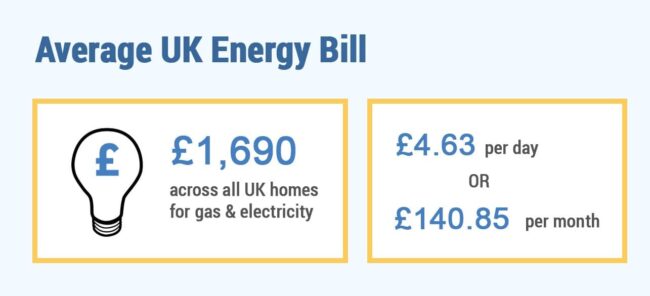
The average UK energy bill is now £1,690 per year across all UK homes for gas and electricity. This works out at £140.85 per month or £4.63 per day. Most energy suppliers base their variable rate tariffs on the Ofgem energy price cap maximum rate leading to the majority of homeowners paying these prices.
- The average dual fuel bill is £1,690 per year
- The average electricity bill is £880.87 per year
- The average gas bill is £809.32 per year
The average consumption data according to Ofgem for all electric and gas meters have the following yearly values:
- Average electricity usage of 2,700 kWh (down from 3,300 kWh) for standard single-rate electric meters averaged across all regions.
- Average gas consumption of 11,500 kWh (previously 16,500 kWh) averaged from all households across all regions in England.
Averages By Property Type
The Ofgem figures above are averages for all property types in all regions of the UK. These vary depending on the size of your house or flat.
Your own consumption may change according to the type and efficiency of the appliances you use, the size of rooms you heat and the number of people residing at the address. The chart below shows some typical scenarios and their average bills.
<= Swipe =>
| Property Type | Electric Usage | Gas Usage | Monthly | Yearly |
| Ofgem Average | 2,700 kWh | 11,500 kWh | £140.85 | £1,690.00 |
| 1-bedroom flat | 2,000 kWh | 0 kWh | £59.11 | £709.37 |
| 2-bedroom flat | 2,000 kWh | 8,000 kWh | £108.94 | £1,307.28 |
| 2-bedroom House | 3,000 kWh | 12,000 kWh | £149.49 | £1,793.88 |
| 3-bedroom House | 4,750 kWh | 17,400 kWh | £212.40 | £2,548.79 |
| 4-bedroom House | 6,000 kWh | 22,600 kWh | £264.09 | £3,169.12 |
| Micro Business | 5,000 kWh | 4,500 kWh | £198.35 | £2,380.15 |
| Small Business | 16,000 kWh | 8,600 kWh | £517.13 | £6,205.58 |
| Medium Business | 35,000 kWh | 12,400 kWh | £1,046.29 | £12,555.46 |
What is The Current UK Electricity Price?
Residential calculations use the Ofgem energy price cap unit rate of 24.50p/kWh for electricity and 6.04p/kWh for gas. The daily standing charge is 60.10p for electricity and 31.43p for gas.
Business electricity prices are 31.85p/kWh for electricity and 7.85p/kWh for gas with a daily standing charge of 78.13p and 40.86p respectively. Figures include 5% VAT for residential with VAT excluded for commercial customers.
Most energy companies quote prices for paying by monthly direct debit, which usually lowers bills by 6%. With the price cap in place, most tariffs are the same between suppliers. There is minimal competition in the marketplace due to the volatility in the wholesale markets. The entire industry is attempting to work with the regulator and government to lower their costs and our invoices.
What if Your Electricity Bill is Higher than the Average?
The average annual electricity bill calculated with Ofgem’s data is £880.87 per year and £809.32 for gas. Other suppliers may charge more or less than this figure. The prices quoted always seem cheaper than the bills we receive because these are averaged across all properties, from studio apartments to large dwellings.
Most people in a three or four-bedroom regular house would usually pay around £300 per month. If you’re in a one or two-bedroom flat, you should pay a lot less.
However, there are areas where these figures are higher. If you’ve just received a higher than average bill, here are possible reasons as to why, and how to sort it out.
- You’re on a standard tariff and have never switched. If you’re on a standard tariff from any of the main electricity suppliers, then you’re probably paying too much. This is always the most expensive tariff for non pre-payment meters. There are easy ways to switch from your current provider. If you also pay by direct debit, you should see savings of between 10-20% per year.
- You have been on estimated bills for more than one quarter. One of the problems in this country is estimated bills which tend to be on the conservative side. Then, suddenly someone comes to read your meter and the real readings get calculated, providing a large debit balance. It’s always best to check the meter readings on your bill or provide your supplier with the readings, so you don’t get a nasty shock.
- Most of the electric providers allow you to submit meter readings online, and British Gas has their energy smart programme which ties this together. If you have been on low estimated bills for many months, your electric company will then want to increase your monthly direct debit to make up the deficit.
- During the winter months when temperatures fall, overall energy demand increases so bills are higher. Your monthly direct debit should not increase during this period.
- You have electric heating, which can be expensive to run. Manage how you use this and see if you can benefit from the lower-priced Economy 7 tariffs that have lower prices during the night. You could also save money by switching to newer appliances that are more energy efficient.
- You use an immersion tank and heating too often. This traditional method is one of the most expensive ways to heat water. If you have a gas heating system try to use this first and avoid using the immersion heating. This is like boiling an electric kettle and is not energy efficient at all.
- You overuse power and should think about efficiency measures. Although more of us are aware of wasting energy, it’s all too easy to leave lights on, not having energy saving lightbulbs installed or simply not thinking about what is switched on in your home. Simple changes in your lifestyle can save a ton of energy and money during the year.
The best thing is not to worry. If you find your bill increases to an amount you’re not comfortable with, or you have trouble paying it, then contact your energy supplier immediately. They can discuss ways to help with your payments and usage and hopefully put things right.
Average Business Electricity Bills
Do businesses pay more or less for their electricity than residential customers? Companies usually pay the same as residential customers for the basic cost of supplying electricity. However, as Jason Smith of Business Electricity Prices explains, businesses have other costs to bear: “The expected unit cost per kWh and daily standing charges are broadly the same for homes and businesses.
Commercial customers, however, have a raft of government levies and additional costs to support various renewable energy environmental initiatives. Businesses also pay VAT at 20% rather than 5%.”
The average electricity bill for a household in the UK is only set to increase over the coming years. Therefore, ensure you find the cheapest electric supplier and try to save as much energy you use daily.